JavaScript runs fast on modern hardware not because it's inherently efficient, but because the engine works hard to make it so. V8 profiles your code as it runs and compiles the hot paths to machine code that rivals what a C compiler would produce — but only if your code cooperates. When it doesn't, you get silent deoptimizations that cost throughput without any obvious error.
V8's Compilation Pipeline
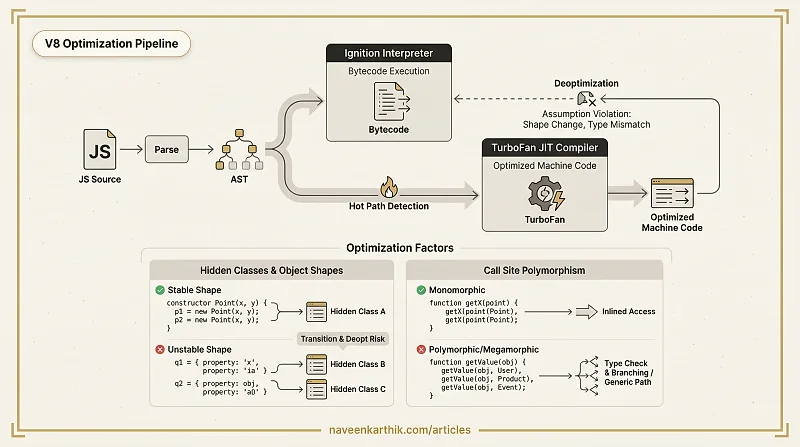
V8 (Chrome, Node.js, Edge) uses a two-tier compilation pipeline:
Ignition is V8's interpreter. It parses JavaScript into an AST, then compiles it to compact bytecode and executes that bytecode directly. Bytecode is faster to generate than machine code and uses less memory, making it ideal for code that runs once or infrequently.
TurboFan is V8's optimizing JIT compiler. It watches which functions are called frequently ("hot" functions), profiles their types and shapes, and compiles them to highly optimized machine code based on those observations.
Hidden Classes
V8 assigns every object a hidden class — an internal descriptor of its shape (the names and order of its properties). When objects share the same shape, V8 can treat them as the same type and use faster property access paths.
Adding properties to an object after construction creates a new hidden class transition:
Initialize all properties in the constructor, in the same order, every time.
Monomorphic vs Polymorphic Call Sites
A function call site is monomorphic if it always receives objects of the same hidden class. TurboFan can inline and specialize the compiled code for that one type.
A polymorphic call site receives 2–4 different types. TurboFan generates a type check and branches.
A megamorphic call site receives many types. TurboFan gives up specializing and falls back to a generic (slower) path.
Keep your hot functions monomorphic by ensuring they always receive the same object shape.
Deoptimization
When TurboFan's assumptions are violated at runtime — a type changes, an unexpected value arrives — it deoptimizes: discards the optimized machine code and falls back to Ignition's bytecode. Deoptimization itself is cheap, but the loss of optimized code hurts throughput.
Common deoptimization triggers:
- Changing an object's shape after construction
- Passing
nullorundefinedto a function that was compiled assuming an object - Using
argumentsobject in non-trivial ways try/catchblocks (V8 historically struggled to optimize these; modern V8 is better)
DevTools → Performance → Bottom-Up shows deoptimization events as Deoptimize entries in the call stack.
Practical Rules for JIT-Friendly Code
Initialize all object properties in the constructor. Don't add properties dynamically after construction.
Keep functions small and focused. TurboFan is more likely to inline and optimize small functions.
Avoid type polymorphism in hot loops. If an array contains mixed types, V8 can't use SIMD-like optimizations.
Don't delete properties. delete obj.x transitions the object to a dictionary mode that bypasses hidden class optimization entirely.
Avoid arguments in hot code. Using arguments as an array prevents several optimizations. Use rest parameters (...args) instead.
Most of these patterns cost nothing at the source level — writing consistent constructors and avoiding post-construction mutation is just good object design anyway. The JIT benefit is a side effect of code that's already easier to reason about.
Deeper dive: See JS V8 #1 — JIT Compilation & Hidden Classes and V8 #3 — Deoptimization Patterns in the JavaScript series for a more detailed walkthrough of V8 internals, including inline caching and concrete deopt patterns.