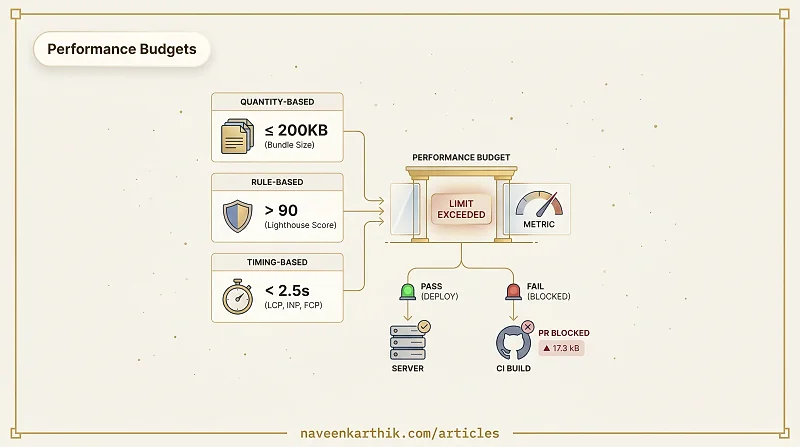
A performance budget is a constraint on a metric — a number your team agrees not to exceed. Without a budget, performance degrades silently: each pull request adds a small cost that seems acceptable in isolation, and six months later the page is twice as slow as it was. Budgets make performance a requirement, not an afterthought.
What a Performance Budget Covers
Budgets can be set on three categories of metrics:
Quantity-based — raw counts and sizes:
- Total JS bundle size (compressed): e.g., < 200KB
- Total page weight: < 1MB
- Number of HTTP requests: < 50
- Image count or total image weight
Rule-based — Lighthouse audit scores:
- Performance score: ≥ 90
- No individual audit below a threshold
Timing-based — field or lab metrics:
- LCP: < 2.5s
- INP: < 200ms
- TBT: < 200ms
- FCP: < 1.8s
Timing-based budgets are the most meaningful but hardest to enforce in CI because they vary by test environment. Start with bundle size budgets — they're deterministic, fast to measure, and directly causally related to performance.
Lighthouse CI
Lighthouse CI runs Lighthouse on every pull request and fails the build if metrics drop below thresholds.
Failed assertions block the PR merge. numberOfRuns: 3 averages multiple runs to reduce variance in the timing metrics. The upload config posts the full Lighthouse report as a link in the PR.
Bundle Size Budgets with size-limit
size-limit by Andrey Sitnik measures the compressed size of your JS bundles and fails CI if they exceed a threshold.
size-limit reports gzip and Brotli sizes by default. It also reports the time to parse and execute the bundle on a simulated slow device — a more meaningful number than raw bytes.
Add it to CI:
A pull request that pushes the bundle over the limit fails immediately, with a clear message showing the delta:
bundlesize (Alternative)
bundlesize is a simpler tool for projects that just need size checks without the parse-time simulation:
Setting Realistic Budgets
Don't set a budget based on what you wish the numbers were. Set it based on where you are now, then tighten it over time.
A practical process:
- Measure current metrics (Lighthouse, bundle sizes) on the main branch.
- Set the initial budget at current values + 10% buffer.
- Tighten the budget by 5–10% each quarter as the team improves the codebase.
- Record the rationale for each budget value — what user experience does it protect?
A budget that's never triggered provides no value. A budget that blocks every PR creates friction without insight. Aim for "fails occasionally, but always for a good reason."
Budget Violations as Learning Opportunities
When a budget fails, the team should understand why before they fix it:
- Was it a new dependency that could be replaced with something lighter?
- Was it a feature that should be code-split and loaded on demand?
- Was it a legitimate new feature that warrants a budget increase?
Treat each failure as a data point about the codebase's trajectory, not just a gate to bypass.
The real value of a performance budget isn't the tooling — it's that it forces a conversation at the point of change, before the regression ships. Size-limit and Lighthouse CI are just the mechanism. The habit of treating performance as a first-class constraint, like correctness or security, is what makes the difference over time.