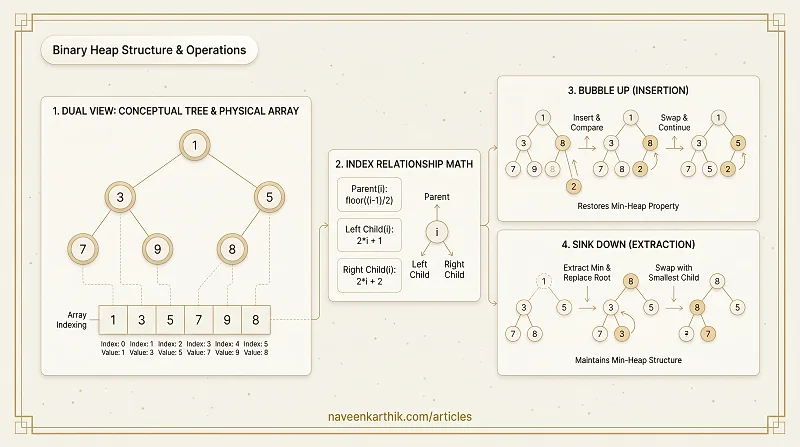
A binary heap is a complete binary tree stored in an array where every parent is smaller (min-heap) or larger (max-heap) than its children. It's the data structure behind priority queues, used in Dijkstra's algorithm, task schedulers, and event loops.
1. The Array Layout — Parent/Child Index Math
The heap is stored as an array where for any node at index i:
- Parent:
Math.floor((i - 1) / 2) - Left child:
2 * i + 1 - Right child:
2 * i + 2
Loading editor...
2. Min-Heap Implementation
Loading editor...
3. Priority Queue Built on Min-Heap
Loading editor...
4. Heapify — Build a Heap from an Array in O(n)
Loading editor...
Key Takeaways
- Heap is stored as an array — no pointers needed. Parent at
(i-1)/2, children at2i+1and2i+2. - Insert: push to end, bubble up — O(log n).
- Extract min: swap root with last, pop, sink down — O(log n).
- Heapify: build heap from unsorted array in O(n) — start from last non-leaf and sink down.
- Priority queue = min-heap where each element has a priority value.
- JavaScript has no built-in heap/priority queue — this implementation is commonly needed for LeetCode problems.
Next: Data Structures #5 — Trie (Prefix Tree) — insert, search, startsWith, and autocomplete.