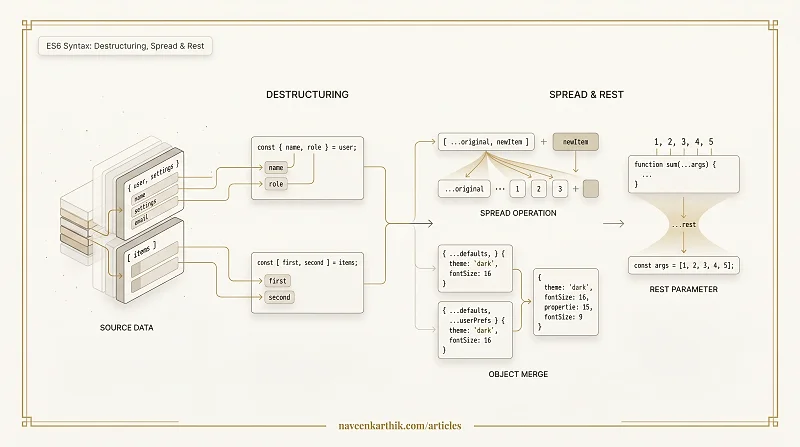
Destructuring, spread, and rest syntax are three of the most-used ES6 features. They replace whole blocks of manual extraction, copying, and argument collection with concise syntax.
Before vs After:
This article covers every variant with runnable examples.
Prerequisites: JS Foundations #1 — Variables & Scope
1. Array Destructuring — Positional Extraction
Extract array values into named variables based on position:
Loading editor...
Swapping variables without a temp — a classic destructuring use case:
Loading editor...
2. Object Destructuring — Named Extraction
Extract object properties by name — order doesn't matter:
Loading editor...
3. Nested Destructuring
Destructure deeply nested structures in one statement:
Loading editor...
4. Destructuring in Function Parameters
The most practical pattern — destructure directly in the function signature:
Loading editor...
The = {} at the end makes the entire parameter optional. Without it, calling the function with no arguments tries to destructure undefined, which throws:
Loading editor...
Always add = {} when a destructured parameter is optional.
5. Spread Operator — Copy and Merge
The ... spread operator "expands" an iterable or object into individual elements:
Loading editor...
6. Spread for Immutable Updates
Spread is the standard way to update state immutably (React, Redux, etc.):
Loading editor...
7. Rest Parameters — Collect Remaining Arguments
Rest parameters collect all remaining arguments into a real array:
Loading editor...
8. Spread vs Rest — Same Syntax, Different Context
... means spread when used to EXPAND (in calls, array/object literals). It means rest when used to COLLECT (in function parameters, destructuring):
Loading editor...
Key Takeaways
- Destructuring replaces manual
obj.propextraction with conciseconst { prop } = obj. - Default values in destructuring prevent
undefinedwhen properties/indices are missing. - Rest parameters (
...args) collect arguments into a real array — always use instead ofarguments. - Spread (
...) creates shallow copies and merges —[...arr],{...obj}. - Spread + map is the standard pattern for immutable state updates.
...means spread when expanding, rest when collecting — context determines meaning.
Next: JS Foundations #8 — Template Literals & Tagged Templates — multiline strings, expression interpolation, and building tagged template functions.