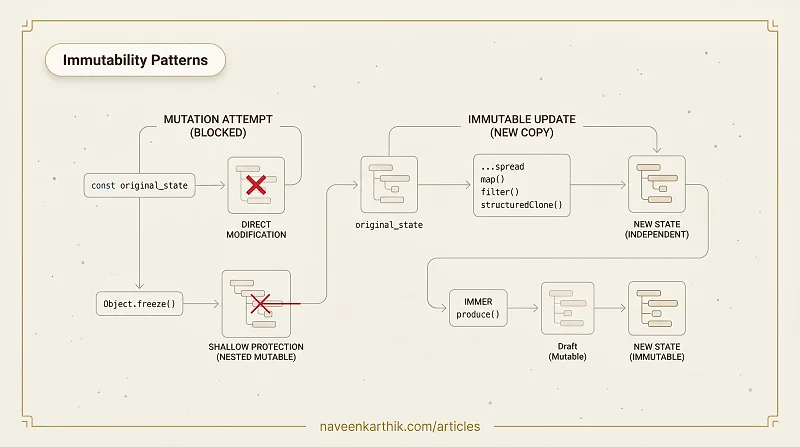
Immutability means never modifying data in place — always creating new copies with changes applied. It prevents accidental mutations, enables reliable change detection, and is foundational to React, Redux, and functional programming. This article covers every immutability pattern in JavaScript.
Prerequisites: Data #1 — Deep Clone
1. Preventing Mutation — const vs Object.freeze
const prevents reassignment. It does NOT prevent mutation:
Loading editor...
Object.freeze() makes an object shallowly immutable:
Loading editor...
2. Deep Freeze — Recursive Immutability
Loading editor...
3. Immutable Updates — Spread, Map, Filter
The standard pattern: return a new copy with changes applied:
Loading editor...
4. structuredClone() — Deep Copy Built Into the Platform
Loading editor...
5. Immer-Style produce() — Write Mutable, Get Immutable
Immer lets you write "mutating" code that actually produces an immutable copy:
Loading editor...
6. Immutability Library Comparison
Loading editor...
Key Takeaways
constprevents reassignment, NOT mutation.Object.freezeis shallow.- Use spread/map/filter for immutable updates — the standard React/Redux pattern.
structuredClone()is the modern deep copy — prefer it over manual implementations.- Immer-style
produce()lets you write "mutating" drafts that produce immutable results. - In production, don't
deepFreezelarge objects — it has a performance cost. Use it in development for debugging.
Next: Web APIs #1 — requestAnimationFrame & requestIdleCallback — sync JS to the display refresh and run low-priority work.