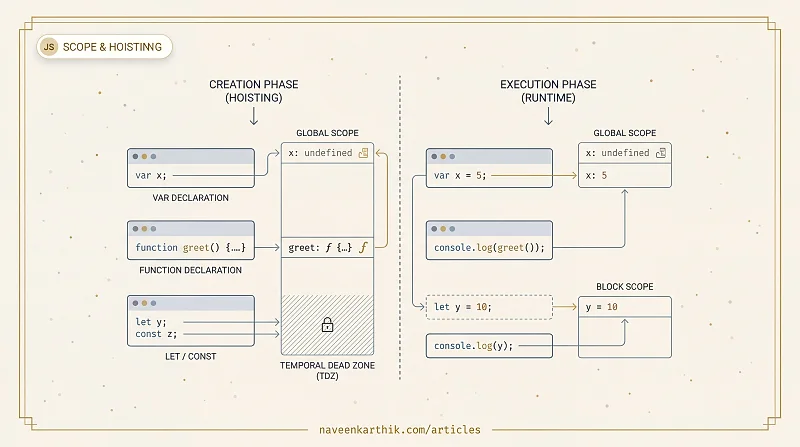
Ten snippets. For each one, predict what gets logged before you expand the answer. The rules being tested — var hoisting, function hoisting, the Temporal Dead Zone, and block scope — come up in almost every JS interview. Get these right and you'll never be surprised by them again.
Q1 — var declaration before assignment
Loading editor...
Show answer
Output:
undefined
5
Why: var declarations are hoisted to the top of their function (or global) scope, but only the declaration is hoisted — not the assignment. The engine treats this as var x; console.log(x); x = 5;. The first log prints undefined because x exists but has not been assigned yet. The second log prints 5 after the assignment runs.
Q2 — Function declaration vs var
Loading editor...
Show answer
Output:
function
undefined
Why: Function declarations are hoisted entirely — both the name and the body. So greet is already a fully usable function before the first console.log. var x is hoisted as a declaration only, so typeof x is "undefined" (not a ReferenceError) before the assignment runs.
Q3 — let in the Temporal Dead Zone
Loading editor...
Show answer
Output:
ReferenceError
Why: let (and const) are also "hoisted" in the sense that the engine knows the variable exists in the block, but they are placed in the Temporal Dead Zone from the start of the block until the declaration line. Any access before the declaration throws a ReferenceError. This is intentional — it prevents the confusing undefined behavior of var.
Q4 — var leaks out of blocks
Loading editor...
Show answer
Output:
string
undefined
Why: var is function-scoped (or global-scoped), not block-scoped. The if block is not a function boundary, so blockVar escapes into the outer scope. let is block-scoped — it ceases to exist outside the {} where it was declared, so typeof blockLet returns "undefined" (no ReferenceError because typeof is safe on undeclared variables).
Q5 — Function declaration wins over var
Loading editor...
Show answer
Output:
number
1
Why: During hoisting, the function declaration is processed first, making foo a function. Then the var foo = 1 assignment runs at runtime and overwrites it with 1. The typeof check and log both happen after the assignment, so foo is 1. If you removed the var foo = 1 line, foo would log [Function: foo].
Q6 — var inside a for loop
Loading editor...
Show answer
Output:
3
undefined
Why: var i is function-scoped, so it leaks out of the for loop. After the loop i is 3 (the value that failed the i < 3 check). let j is block-scoped to the for statement — it doesn't exist outside the loop, so typeof j is "undefined".
Q7 — Nested scope and shadowing
Loading editor...
Show answer
Output:
undefined
inner
outer
Why: Inside test(), var x is hoisted to the top of the function, creating a shadow of the outer x. At the first console.log, the inner x exists (hoisted) but hasn't been assigned yet — undefined. After the assignment it becomes "inner". The outer x is unaffected, so the final log is "outer".
Q8 — const must be initialised
Loading editor...
Show answer
Output:
SyntaxError
Why: const requires an initialiser at the point of declaration — const c; is a syntax error, not just a runtime error. The engine catches it before any code runs. You can't declare a const and assign it later; the initial value must be provided on the same line.
Q9 — Hoisting across multiple var declarations
Loading editor...
Show answer
Output:
undefined undefined
1 2
Why: Both var a and var b are hoisted to the top of run(), but both start as undefined until their assignments execute. The first log fires before either assignment, printing undefined undefined. The second fires after both assignments.
Q10 — let in a nested block
Loading editor...
Show answer
Output:
ReferenceError (caught if not wrapped in try/catch)
block
global
Why: Inside the {} block, let x = "block" creates a new binding that shadows the outer x. But from the start of that block until the let x line, the inner x is in the TDZ. The first console.log(x) inside the block is in the TDZ — it throws a ReferenceError. After the declaration, the block's x is "block". The outer x remains "global" throughout.
Key Rules
| Keyword | Hoisted? | Initial value | Scope | TDZ? |
|---|---|---|---|---|
var | Yes | undefined | Function / global | No |
let | Yes (TDZ) | — | Block | Yes |
const | Yes (TDZ) | — | Block | Yes |
function declaration | Yes (fully) | The function | Function / global | No |
Go Deeper
- JS Foundations #1 — Variables, Scope & Hoisting — full breakdown with execution context diagrams
- Engine #1 — Hoisting & TDZ: What the Engine Actually Does — how the parser creates bindings before any code runs
- Output Quiz #2 — Closures & the Loop Problem — the next quiz in this series