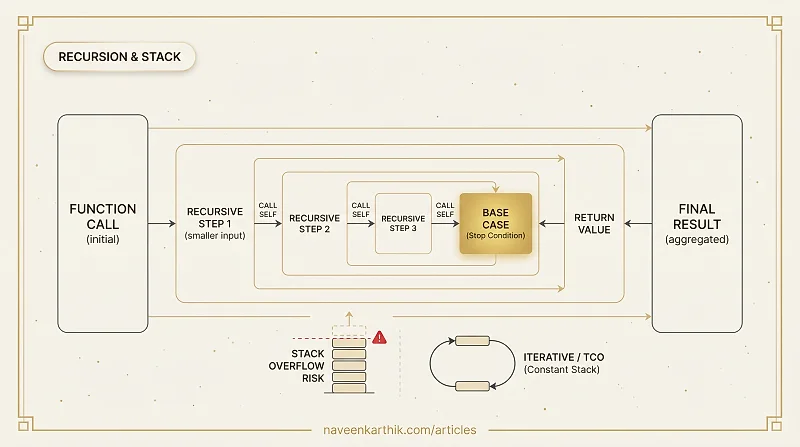
Recursion is a function that calls itself. It's the natural way to process trees, generate combinations, and traverse nested structures. This article covers core recursive patterns, the stack overflow problem, tail-call optimization, and iterative alternatives.
1. The Anatomy of a Recursive Function
Every recursive function has two parts: a base case (stop condition) and a recursive case (call itself with a smaller problem):
Loading editor...
Without a base case, you get infinite recursion → stack overflow. Every function call consumes stack memory, and the stack is finite.
2. Deep Flatten — Recursive vs Iterative
Loading editor...
3. Fibonacci — Three Ways
Loading editor...
4. Tree Traversal
Loading editor...
5. Generating All Permutations
Loading editor...
6. Generating All Combinations (Powerset)
Loading editor...
7. Tail-Call Optimization (TCO)
A recursive call is in tail position if it's the very last thing the function does. JavaScript engines can optimize tail calls to avoid stack growth, but only Safari/JSC currently implements TCO:
Loading editor...
8. Trampolining — Manual TCO When the Engine Doesn't Support It
Loading editor...
Key Takeaways
- Every recursive function needs a base case — without it, stack overflow.
- Deep recursion is elegant but can overflow the call stack on large/deep inputs.
- Memoization turns exponential recursive algorithms (Fibonacci) into O(n).
- Iterative + stack is the stack-safe alternative when the engine doesn't do TCO.
- Trampolining enables unbounded recursion by returning thunks a trampoline function executes in a loop.
Next: Data #1 — Deep Clone & Deep Compare — structural clone handling circular references and deep equality checking.