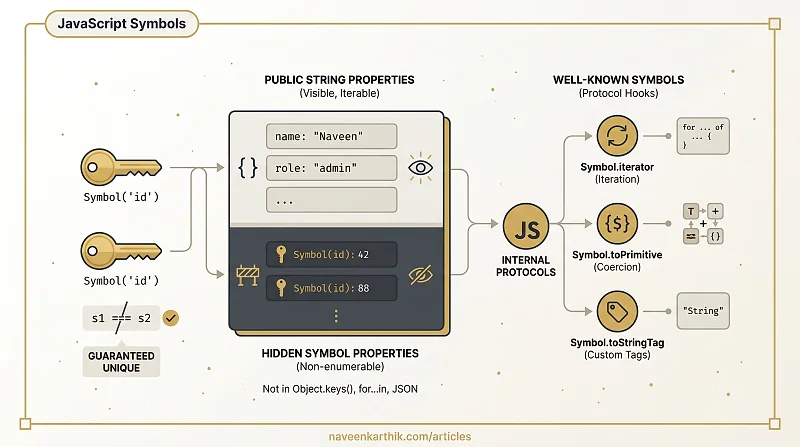
Symbols are the 7th primitive type in JavaScript. They solve a concrete problem: guaranteed-unique property keys.
Before Symbols, if two libraries both added a property called "id" to the same object, one would silently overwrite the other. The workaround was ugly prefixed strings like "__myLib_id_abc123". Symbols fix this: Symbol("id") is never equal to another Symbol("id"), so collisions are impossible.
Beyond unique keys, Symbols also let you hook into JavaScript's internal protocols through well-known symbols — making objects iterable, controlling type coercion, customizing instanceof, and more. This article covers both aspects.
Prerequisites: JS Foundations #4 — Prototypes
1. Creating Symbols — Guaranteed Unique
Every Symbol() call returns a completely unique value — even if you give them the same description:
Loading editor...
2. Symbols as Object Keys — Hidden Properties
Symbol-keyed properties don't appear in Object.keys(), for...in, or JSON.stringify():
Loading editor...
This makes them useful for "soft" private properties — not truly private (still accessible via getOwnPropertySymbols), but hidden from casual iteration.
3. Global Symbol Registry — Symbol.for() and Symbol.keyFor()
The global symbol registry lets you share symbols across realms/frames:
Loading editor...
4. Well-Known Symbols — Hooking Into JavaScript
JavaScript uses well-known symbols to let you customize object behavior:
Symbol.iterator — Make Objects Iterable
Loading editor...
Symbol.toPrimitive — Control Type Coercion
Loading editor...
Symbol.toStringTag — Custom Object.prototype.toString()
Loading editor...
Symbol.hasInstance — Custom instanceof
Loading editor...
5. All Well-Known Symbols at a Glance
Loading editor...
Key Takeaways
- Symbols are unique —
Symbol("x") !== Symbol("x"). Use them for non-colliding keys. - Symbol-keyed properties are hidden from
Object.keys(),for...in, andJSON.stringify(). - Use
Symbol.for("key")for shared global symbols;Symbol.keyFor()to retrieve the key. - Well-known symbols let you hook into JavaScript's built-in protocols — iterator, coercion, instanceof, string tags.
Symbol.toPrimitiveis the most powerful control over how your object behaves in+,${}, and numeric contexts.
Next: Proxy & Reflect — Validation, Observables & Traps — intercept fundamental operations with all 13 proxy traps.