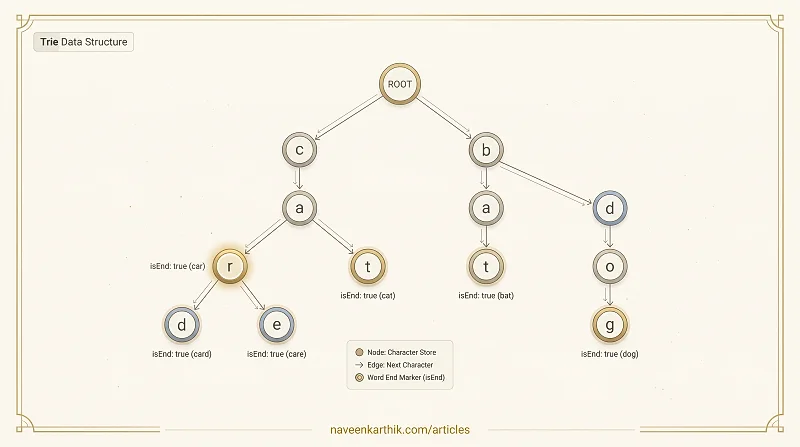
A Trie (prefix tree) stores strings character by character, sharing common prefixes. It enables O(k) lookup where k is the key length — independent of how many keys you've stored. Tries power autocomplete, spell checkers, and IP routing.
1. Basic Trie — Insert, Search, startsWith
Loading editor...
2. Autocomplete — Find All Words with a Prefix
Loading editor...
3. Delete a Word from a Trie
Loading editor...
4. Count Words with a Given Prefix
Loading editor...
5. When to Use a Trie vs Hash Map
Loading editor...
Key Takeaways
- Trie = tree where each character is a node, and
isEndmarks complete words. - insert/search/startsWith are all O(k) where k = key length.
- Autocomplete: navigate to prefix node, then DFS to collect all complete words.
- Delete: unset
isEnd, prune nodes that have no children and aren't an end. - Memory-heavy for large alphabets — compress with radix tree (Patricia trie) if needed.
- Tries shine for prefix search, autocomplete, spell checkers, and IP routing tables.
Next: FP #1 — compose() & pipe() — implement function composition and build transformation pipelines.