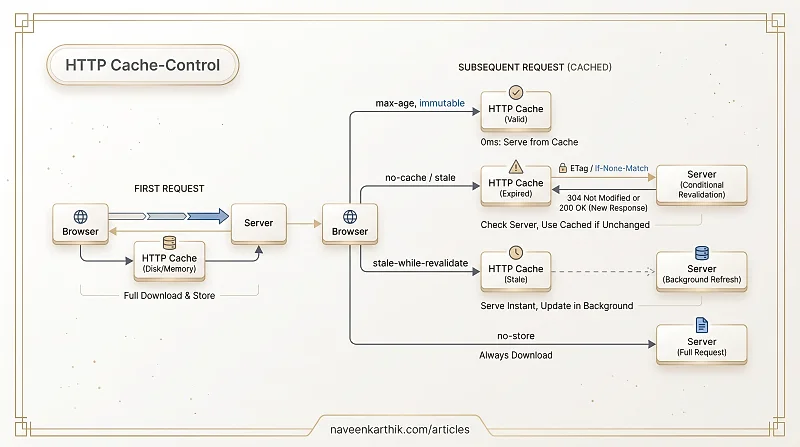
Cache-Control is the HTTP header that tells browsers and intermediate caches (CDNs, proxies) how to store and reuse a response. Getting it right means returning users load your page without a single network request. Getting it wrong means re-downloading resources that haven't changed, or worse, showing stale data that has.
How the Browser Cache Works
On the first request, the browser downloads the resource and stores it in its HTTP cache (disk or memory, depending on size and usage). On subsequent requests, the browser checks its cache first:
Cache-Control controls every decision in that flow: whether to cache, how long to cache, and whether to revalidate before using.
Key Directives
max-age=N
Cache the response for N seconds. The browser uses the cached copy without contacting the server until the time expires.
no-cache
Cache the response, but always revalidate with the server before using it. The browser sends a conditional request (using ETag or Last-Modified). If the server responds 304 Not Modified, the cached copy is used. If the resource changed, the server sends the full response.
no-store
Do not cache at all. Every request goes to the server.
immutable
The resource will never change during its max-age. The browser skips the revalidation request entirely — even when the user hits Refresh. Only use with versioned filenames (app.abc123.js).
public vs private
public allows shared caches (CDNs, proxies) to store the response. private restricts caching to the browser only.
stale-while-revalidate=N
Serve the cached (stale) response immediately, then fetch a fresh version in the background for the next request:
ETag: Conditional Revalidation
When max-age expires, the browser doesn't necessarily re-download. It sends a conditional request:
The ETag is a fingerprint of the response content — like a hash. If it matches, the server returns 304 Not Modified and the browser uses its cached copy. No body is transferred.
Cache Strategy by Resource Type
| Resource | Strategy | Header |
|---|---|---|
Versioned JS/CSS (app.abc123.js) | Cache forever | max-age=31536000, immutable |
| HTML document | Always revalidate | no-cache |
| API response (public data) | Short cache, stale fallback | max-age=60, stale-while-revalidate=300 |
| API response (user data) | Private, short-lived | private, max-age=0 |
| Fonts, images (versioned) | Cache forever | max-age=31536000, immutable |
Cache-Control is the highest-leverage performance header. One correct response header on your static assets eliminates every subsequent network request for that resource. The key distinction is versioned (immutable, forever cache) vs unversioned (revalidate) — once you design your asset pipeline around content hashes in filenames, caching becomes a simple rule with no edge cases.