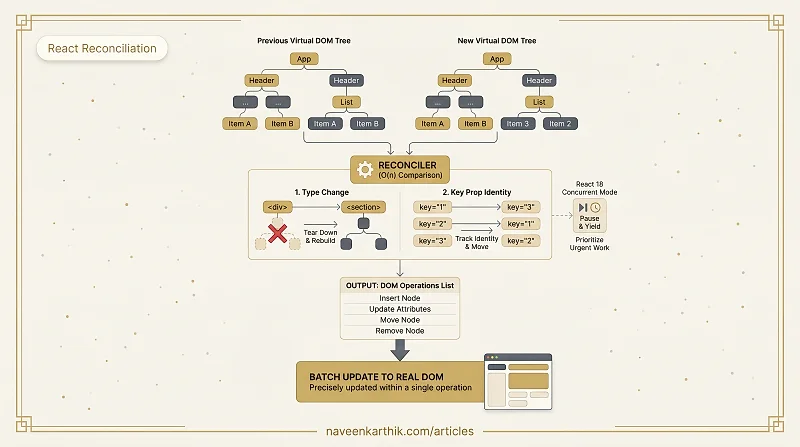
Reconciliation is React's process of figuring out what changed between two renders and updating the real DOM to match — with as few mutations as possible.
When state or props change, React re-runs your component to produce a new Virtual DOM tree. Reconciliation is what happens next: React compares the new tree against the previous one, finds the differences, and generates a minimal list of DOM mutations to apply.
The naive approach and why React doesn't use it
Comparing two arbitrary trees to find the minimum edit distance is an O(n³) problem. On a tree with 1,000 nodes, that's a billion comparisons per render — far too slow for interactive UIs.
React's reconciler makes two pragmatic assumptions that bring this down to O(n):
1. Elements of different types produce completely different trees.
If a <div> becomes a <section>, React tears down the entire subtree and builds a fresh one. It doesn't try to patch the existing nodes.
2. The key prop identifies which list items are the same across renders.
Without keys, React matches list children by position. If items reorder, React re-renders every item. With stable keys, React tracks identity — it knows item #42 moved from position 3 to position 1 and only updates the DOM order.
What reconciliation produces
The output of reconciliation is a list of DOM operations:
- Insert node
- Update node attributes / text content
- Move node
- Remove node
React hands this list to the renderer (ReactDOM for the browser), which applies all the mutations in one batch. One flush, one layout pass, one repaint — regardless of how many virtual nodes changed.
Reconciliation in React 18
React 17's reconciler was synchronous: once it started, it ran to completion. A large tree on a slow device could block the main thread for hundreds of milliseconds.
React 18's concurrent reconciler can pause mid-way through a render, yield the main thread back to the browser (so it can handle input or draw a frame), then resume where it left off. This is what useTransition and Suspense build on — they let React deprioritise certain updates so urgent work (like responding to keyboard input) always gets through first.
Reconciliation is why React can let you think about your UI as a pure function of state — "given this data, render this" — while the browser only ever sees the small, precise updates that actually changed.