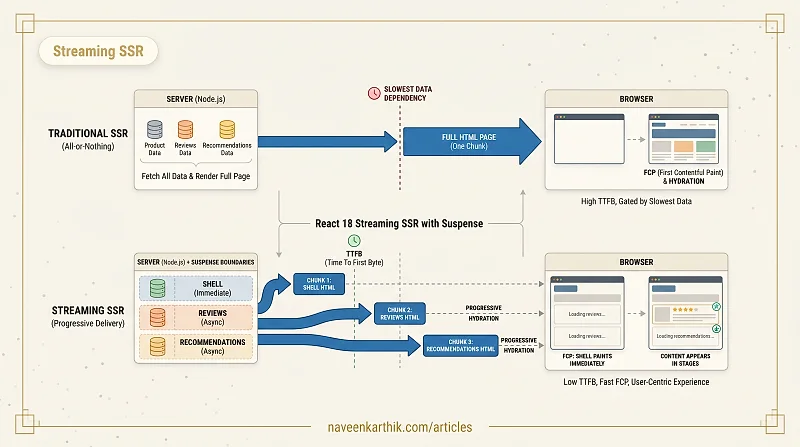
Streaming SSR is a rendering technique where the server sends HTML to the browser in chunks as each component's data resolves, rather than waiting for the full page to be ready. The browser can render and display the early chunks while slower parts are still being prepared on the server.
Traditional SSR vs Streaming SSR
In traditional SSR, the request-response flow is all-or-nothing:
In streaming SSR, the server sends HTML progressively:
The slowest data dependency no longer blocks everything before it. The page appears in stages, with each section rendered as soon as its data is available.
How It Works With React Suspense
React 18 introduced streaming SSR built on Suspense. Components wrapped in a Suspense boundary can stream independently:
The browser receives:
The server uses renderToPipeableStream (Node.js) to send chunks as they become ready. The client hydrates progressively, matching each streamed chunk to its Suspense boundary.
What Streaming Changes
| Traditional SSR | Streaming SSR | |
|---|---|---|
| TTFB | High — server must render the full page first | Low — shell arrives immediately |
| FCP | Gated by the slowest data fetch | Fast — shell paints while data streams in |
| User perception | Blank screen until everything is ready | Progressive — content appears in stages |
| Timeout handling | Entire page fails or takes as long as the slowest component | Each Suspense boundary can have its own fallback/timeout |
When to Use It
Streaming SSR is most valuable when your page has data dependencies with significantly different latencies. A product page where the product details are fast (cached, indexed DB query) but reviews are slow (needs aggregation from a separate service) is the ideal case.
It's less useful when all data resolves at roughly the same speed — the streaming overhead adds complexity without meaningful benefit.
Framework Support
Next.js (App Router) and Remix support streaming SSR natively. In Next.js App Router, every async Server Component that uses <Suspense> boundaries enables streaming:
No configuration — the framework detects Suspense boundaries and automatically streams.
Streaming SSR collapses the tradeoff between SSR's fast FCP and the responsiveness of a client-rendered app. The shell arrives at TTFB speed, and the heavy parts stream in as they're ready, without blocking the parts that are already done.