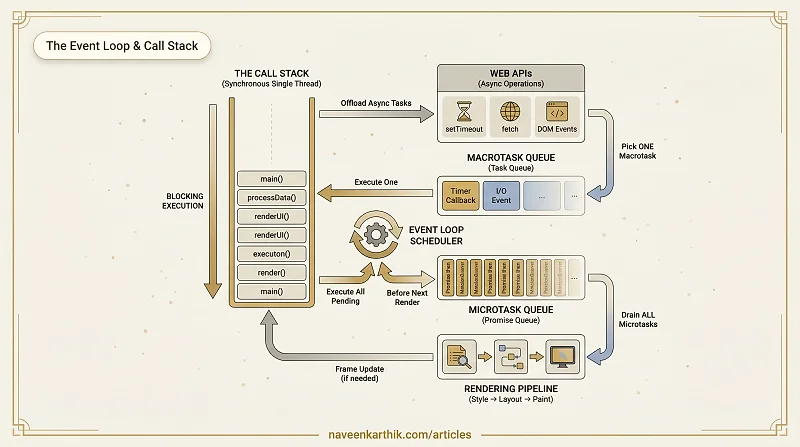
JavaScript runs on a single thread. That one fact explains most performance problems you'll ever debug — frozen pages, janky animations, click handlers that feel sluggish. The event loop is just the scheduling mechanism that decides what runs on that thread and when. Once you see it clearly, a lot of browser behavior that felt arbitrary starts making sense.
The Call Stack
The call stack is where synchronous JavaScript executes. When you call a function, it's pushed onto the stack. When it returns, it's popped off. The stack can only run one frame at a time.
When the stack is busy, nothing else can run — not a click handler, not a paint, not a layout recalculation. A function that takes 500ms to complete will block the page for 500ms.
Web APIs and the Task Queue
Async operations — setTimeout, fetch, DOM events, IndexedDB — are handled by Web APIs provided by the browser, outside the JS engine. When they complete, they queue a callback (also called a macrotask or task) into the task queue.
The event loop follows a strict algorithm — here it is step by step:
- Pick one macrotask from the task queue and run it to completion (push it onto the call stack, execute every synchronous instruction, pop it off).
- Drain all microtasks. After the macrotask finishes, run every pending microtask in the queue. New microtasks added during this phase also run before moving on — the queue must be completely empty.
- Run
requestAnimationFramecallbacks (if the browser decides it's time for a new frame). - Render — recalculate styles, layout, paint, and composite (if needed and frame budget allows).
- Repeat — go back to step 1.
This is why a slow macrotask blocks everything: the event loop can't move to step 2 (microtasks) or step 4 (rendering) until the current macrotask finishes.
Microtasks vs Macrotasks
This is where most developers get confused.
Why the names? Macrotasks are the "big" units — one per event-loop tick, each representing a discrete piece of work. Microtasks are the "small" units that run immediately after the current macrotask, before the next one. Think of it as: one macrotask, then a burst of microtasks, then repeat.
Macrotasks (task queue): setTimeout, setInterval, setImmediate, I/O callbacks, UI events.
Microtasks (microtask queue): Promise.then/.catch/.finally, queueMicrotask, MutationObserver.
The critical difference: after every macrotask, the browser drains the entire microtask queue before doing anything else — including rendering. This means:
And if your microtask queue chains infinitely, you get microtask starvation — the event loop never escapes step 2, so rendering and user input are blocked indefinitely:
Long Tasks
A long task is any task that runs for more than 50ms on the main thread. During a long task, the browser cannot render a frame, respond to input, or run anything else.
Long tasks are the primary cause of poor INP (Interaction to Next Paint). The browser's task scheduler shows them highlighted in red in the Performance panel.
Common sources:
- Large JSON parsing (
JSON.parseon a 5MB response) - Synchronous loops over large datasets
- React re-renders of large tree with no memoization
- Third-party script initialization
Breaking Up Long Tasks
The fix is to yield back to the browser between chunks of work. Without yielding, the browser is locked out for the entire duration of the task:
scheduler.yield() (Chrome 129+) is the modern API for this — it yields with higher priority than setTimeout(fn, 0), resuming before other pending macrotasks.
requestIdleCallback
For non-urgent background work (analytics, prefetching, cache warming), requestIdleCallback runs your callback only when the browser has idle time between frames.
This keeps all main-thread time available for user interactions and rendering.
The event loop isn't an implementation detail you can safely ignore — it's the reason setTimeout(fn, 0) isn't actually instant, why Promises resolve before timers, and why a poorly chunked data import can make your entire UI unresponsive. If INP is your biggest CWV problem, tracing long tasks on the main thread is almost always where the fix starts.