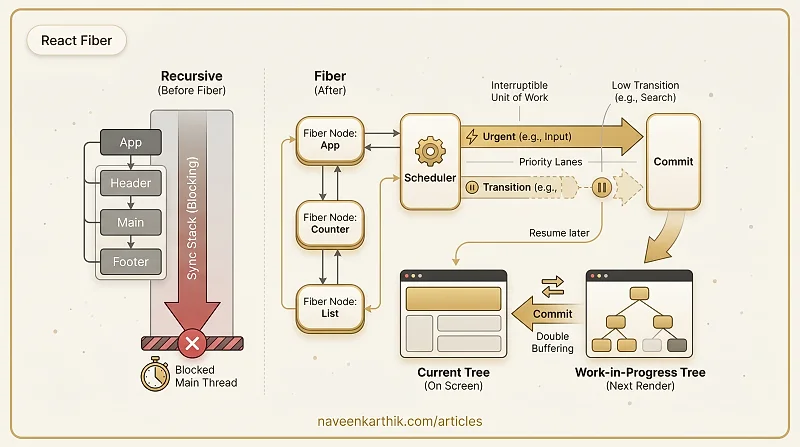
React Fiber is the internal architecture React has used since version 16. It's the reimplementation of React's core reconciliation algorithm — built specifically to make rendering interruptible, prioritisable, and resumable.
Before Fiber, React's reconciler was recursive and synchronous. Once it started rendering a tree, it couldn't stop until it finished. On a large tree, that could block the main thread for hundreds of milliseconds. Fiber was built to fix this.
What a Fiber is
A fiber (lowercase) is a JavaScript object representing a unit of work — specifically, one component in the component tree. It holds:
- The component type (function, class, or host element like
div) - The component's props and state
- A reference to its parent, child, and sibling fibers (a linked list, not a tree)
- Information about what work needs to be done (effect flags)
App fiber
├── Header fiber
│   └── Nav fiber
├── Main fiber
│   ├── Article fiber
│   └── Sidebar fiber
└── Footer fiber
Each fiber is a node in a doubly-linked list that React can walk, pause, resume, and abandon.
Why a linked list and not a tree?
The original recursive reconciler used the JavaScript call stack to track where it was in the component tree. If you interrupted a recursive call, you lost your place — there was no way to resume.
A linked list is different: React tracks its current position explicitly as a pointer. It can stop processing at any fiber, save the pointer, hand the thread back to the browser, and resume from the same fiber on the next frame. No call stack required.
Two trees: current and work-in-progress
React maintains two fiber trees at all times:
- Current tree — reflects what is currently rendered on screen
- Work-in-progress tree — where React applies the next render
When reconciliation starts, React builds a work-in-progress fiber for each component. Once the work-in-progress tree is complete and all effects have run, it becomes the new current tree (a "commit"). This is the double-buffering pattern.
Current tree:         Work-in-progress tree (being built):
[App] ←────────────── [App'] (new state)
 └─ [Counter: 0]       └─ [Counter': 1]  ← only this changed
React only commits the work-in-progress tree to the DOM when the entire tree is ready — you never see a half-updated UI.
How concurrent rendering uses Fiber
In React 18's concurrent mode, the scheduler assigns priority lanes to updates:
| Priority | Example |
|---|---|
| Synchronous | Error boundaries, flushSync |
| Default | State updates from user events |
| Transition | startTransition updates |
| Idle | Prefetching, background work |
React processes fibers in priority order. A high-priority update (keyboard input) can interrupt a low-priority render in progress (a slow search results list). React abandons the work-in-progress tree, handles the urgent update, then restarts the interrupted render.
Without Fiber's interruptible linked-list model, startTransition and Suspense couldn't exist.
Fiber as a concept vs. the Fiber reconciler
"Fiber" can refer to either:
- An individual fiber object (one component's work unit)
- The Fiber reconciler — the entire React 16+ architecture
In reconciliation, React walks the fiber tree, compares each fiber to its previous version, and marks which ones need updates. Fiber is the data structure that makes this efficient and interruptible.
Fiber isn't something you use directly — it's the engine underneath React. But knowing it exists explains why React can pause rendering mid-tree, why concurrent features work the way they do, and why splitting work across frames is possible at all.