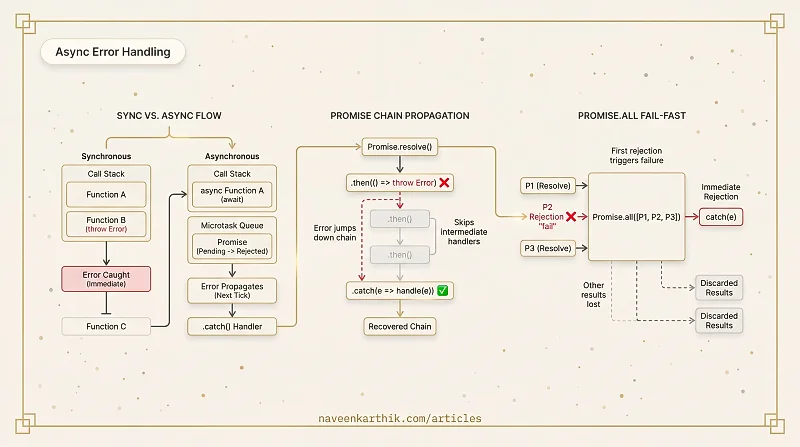
Async error handling has more moving parts than synchronous code — errors jump queues, try/catch doesn't cover bare calls, and Promise.all silently discards results on failure. Ten output questions tracing how errors move through async call stacks, combining .catch() chains, async function layers, and timing.
Q1 — throw inside async function creates a rejected Promise
Loading editor...
Show answer
Output:
true
after boom()
caught: async error
Why: A throw inside an async function is automatically converted to a rejected Promise. The calling code is unaffected synchronously — the rejection is handled as a microtask. "after boom()" logs first, then the .catch() fires.
Q2 — Promise.reject() with no .catch()
Loading editor...
Show answer
Output:
sync after reject
caught: oops
Why: Promise.reject("oops") creates a rejected Promise immediately. The .catch() is attached synchronously (same microtask timing), so the rejection is handled. If there were a gap — if .catch() was added in a setTimeout — the unhandled rejection would fire first. This is why .catch() registration timing matters.
Q3 — Error in Promise executor is NOT catchable by sync try/catch
Loading editor...
Show answer
Output: (nothing logs — the error is silently converted to a rejection)
Why: The throw inside the Promise executor is caught by the Promise constructor, which converts it to a rejection — it never escapes to the outer try/catch. The outer catch block is never reached. To handle this error, you need .catch() on the Promise itself. The synchronous try/catch around new Promise(...) cannot intercept executor errors.
Q4 — .catch() returning a value recovers the chain
Loading editor...
Show answer
Output:
first catch: initial
then: 42
Why: The first .catch() returns 42 — a plain value. This converts the chain back to the resolved track. The .then() runs and receives 42. The second .catch() is never reached because the chain is no longer rejected. Recovery: handle, return something useful, and the chain continues normally.
Q5 — .catch() that re-throws keeps the chain rejected
Loading editor...
Show answer
Output:
catcher: first error
final catch: second error
Why: The first .catch() re-throws (throw "second error"), which keeps the chain on the rejected track. The .then() is skipped. The second .catch() catches "second error". Re-throwing is how you inspect an error and decide it's not recoverable — the error propagates further down the chain.
Q6 — Promise.all discards results on first rejection
Loading editor...
Show answer
Output:
caught: fail
Why: Promise.all is fail-fast — it rejects with the first rejection reason. The resolved values from p1 and p3 are discarded. The Promises themselves still resolve (you could still .then() on p1 individually), but their values are lost from the Promise.all result. If you need all results even with failures, use Promise.allSettled.
Q7 — Chained async function calls propagate errors through await
Loading editor...
Show answer
Output:
caught at top: deep
Why: Errors propagate up the await chain. level3() rejects → level2()'s await on it re-throws → level2() returns a rejected Promise → level1()'s await on it re-throws → level1()'s catch intercepts. This is why async/await is preferred for multi-layer async — error propagation works like synchronous error propagation through call stacks.
Q8 — try/catch without await doesn't cover the async function's body
Loading editor...
Show answer
Output:
catch on call: late error
Why: try { fetch() } without await only catches errors thrown synchronously by fetch() — which returns a Promise (not an error) because the throw happens after await. The synchronous catch block is never reached. To catch the error, you must either await fetch() inside the try, or attach .catch() to the returned Promise. This is the root cause of countless unhandled rejection bugs.
Q9 — Unhandled rejection in .then() chain catches
Loading editor...
Show answer
Output:
sync
(UnhandledPromiseRejection warning in Node)
Why: The error thrown in the first .then() propagates down the chain looking for a .catch(). There is none in this snippet — the chain ends without a rejection handler. This triggers an UnhandledPromiseRejection. "sync" logs first (the rejection happens as a microtask). The fix: always end a .then() chain with .catch(), or use try/catch with await.
Q10 — Long .then() chain — where does the 3rd .then()'s error end up?
Loading editor...
Show answer
Output:
t1: 1
t2: 2
catch: bad
Why: t1 logs 1 and returns 2. t2 logs 2 and throws "bad". The error jumps past t3 and t4 (both skipped) and lands in the .catch() at the end. Errors in a .then() chain skip all subsequent .then() handlers and jump to the nearest .catch() — wherever it appears in the chain. This is why .catch() at the end of the chain is the standard pattern.
Key Rules
| Scenario | What happens |
|---|---|
throw in async fn | Returned Promise becomes rejected; callers are unaffected synchronously |
Promise.reject() unattached | unhandledrejection event fires if .catch() isn't attached in the same microtask round |
throw in Promise executor | Caught by the constructor — converted to rejection; NOT catchable by outer try/catch |
.catch() returns plain value | Chain recovers to resolved; next .then() receives that value |
.catch() re-throws | Chain stays rejected; next .catch() in line fires |
Promise.all with rejection | Fail-fast — only first rejection reason surfaces; other values lost |
Error through await chain | Propagates up like sync call stack — each await re-throws |
try { asyncFn() } without await | Does NOT cover errors inside asyncFn's body |
.then() error without .catch() | Jumps down the chain; unhandled rejection if no catch exists |
Go Deeper
- Output Quiz #10 — setTimeout + Promises: Real-World Interleaving — the previous quiz
- Output Quiz #12 — Microtask Queue: Breadth-First Ordering — the next quiz
- Output Quiz #7 — Promise Chaining & the .catch() Recovery Rules — deeper on .catch() recovery vs re-throw
- Output Quiz #9 — async/await Patterns — return vs return await trap