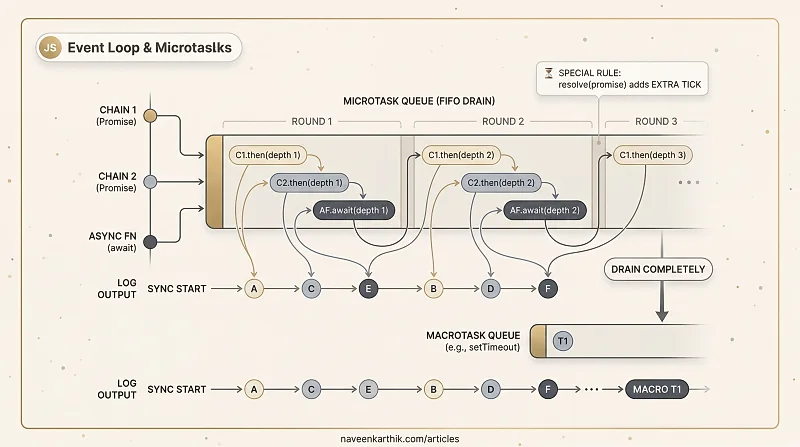
Two concurrent chains interleave breadth-first, not depth-first — this single fact is wrong in more senior JS interviews than any other async concept. Ten questions building from two-chain interleaving to the full microtask tick-by-tick model, including the resolve(promise) extra-tick rule and three async function interleaving.
Q1 — Two concurrent chains: breadth-first, not depth-first
Loading editor...
Show answer
Output:
A
C
B
D
Why: At the end of synchronous code, the microtask queue has two entries: [cbA, cbC]. cbA runs → logs "A" → schedules cbB at the end of the queue. Queue: [cbC, cbB]. cbC runs → logs "C" → schedules cbD. Queue: [cbB, cbD]. cbB → "B"; cbD → "D". This is breadth-first interleaving — the chains alternate depth levels. Most developers expect "A B C D".
Q2 — Why breadth-first matters
Loading editor...
Show answer
Output:
1
4
2
5
3
Why: Start: microtask queue [cb1, cb4]. cb1 runs → 1 → schedules cb2. Queue: [cb4, cb2]. cb4 runs → 4 → schedules cb5. Queue: [cb2, cb5]. cb2 runs → 2 → schedules cb3. Queue: [cb5, cb3]. cb5 → 5; cb3 → 3. Each depth level from each chain runs before the next level from any chain. 3 comes last even though it started first.
Q3 — Three concurrent chains
Loading editor...
Show answer
Output:
A
C
E
B
D
F
Why: Three chains, same rule. Microtask queue initially: [A, C, E]. A runs → schedules B. C runs → schedules D. E runs → schedules F. Queue: [B, D, F]. All three depth-1 callbacks run before any depth-2 callback. Breadth-first means each "round" of the microtask queue processes one .then() from each chain, then the next round, and so on.
Q4 — queueMicrotask vs Promise.resolve().then()
Loading editor...
Show answer
Output:
A
B
C
Why: queueMicrotask and Promise.resolve().then() both schedule to the same microtask queue. They are ordered by insertion. "A" is queued first, then "B", then "C". So: A, B, C. There is no priority difference — the queue is a simple FIFO. Use either API, but be consistent in your mental model: they're the same thing.
Q5 — queueMicrotask from inside a .then() handler
Loading editor...
Show answer
Output:
A
C
B
Why: Microtask queue initially: [cbA, cbC]. cbA runs → logs "A" → queues qmB at the end. Queue: [cbC, qmB]. cbC runs → "C". Then qmB → "B". The queueMicrotask from inside a .then() doesn't jump ahead — it goes to the back of the current microtask queue and runs before the next macrotask, but after already-scheduled microtasks.
Q6 — Three async functions called back-to-back: exact interleaving
Loading editor...
Show answer
Output:
f1-sync
f2-sync
f3-sync
global
f1-end
f2-end
f3-end
Why: The pre-await code in each async function runs synchronously as part of the call. So f1-sync, f2-sync, f3-sync all run in order. Then "global". Each await null suspends and schedules its continuation as a microtask, in order: [f1-end, f2-end, f3-end]. Microtask drain: f1-end, f2-end, f3-end. Simple FIFO because each only has one await.
Q7 — Async function with two await points
Loading editor...
Show answer
Output:
A1
B1
sync
A2
B2
A3
Why: Sync: A1, B1, "sync". First microtask round: [A2, B2]. A2 runs → schedules A3. B2 runs. Second microtask round: [A3]. A3 runs. So A2 runs before B2 (FIFO in round 1), but A3 is scheduled in round 2 and runs after B2. The second await creates a natural depth break — A3 goes one round deeper than A2.
Q8 — Nested microtask scheduling: all drain before next macrotask
Loading editor...
Show answer
Output:
1
2
3
timeout
Why: Microtask drains before the setTimeout macrotask. 1 logs, schedules microtask for 2. Microtask queue now: [log2]. 2 logs, schedules microtask for 3. Queue: [log3]. 3 logs. Queue now empty. Then — and only then — the setTimeout macrotask runs: "timeout". No matter how deep the nested microtask chain goes, all must drain before the next macrotask.
Q9 — resolve(promise) gets one extra microtask tick
Loading editor...
Show answer
Output:
plain: 42
inner: inner
outer: inner
Why: resolve(42) is a plain value — the .then() is queued immediately. resolve(inner) triggers Promise adoption — the engine must call inner.then(resolveOuter, rejectOuter), which is itself a microtask.
Timeline:
- Sync ends. Microtask queue:
[adopt inner→outer, cb "plain: 42", cb "inner: inner"] adoptruns →outerresolves → queuescb "outer: inner". Queue:[cb "plain: 42", cb "inner: inner", cb "outer: inner"]"plain: 42"logs, then"inner: inner", then"outer: inner".
The extra adoption tick pushes outer's .then() one position later — behind inner's own .then() and behind the plain-value chain's .then().
Q10 — Full complexity: 3 async functions + queueMicrotasks + setTimeout
Loading editor...
Show answer
Output:
A
D
SYNC
B
E
QM1
P1
QM2
C
T1
Why: Full tick-by-tick trace:
Sync: A, D, "SYNC". After sync:
- Microtask queue:
[B, E, QM1, P1, QM2]— f1's first continuation, f2's continuation, then the three sync-scheduled microtasks in order. - Macrotask queue:
[T1]
Microtask drain — round 1:
Bruns → schedulesC(new microtask). Queue:[E, QM1, P1, QM2, C]Eruns. Queue:[QM1, P1, QM2, C]QM1runs. Queue:[P1, QM2, C]P1runs. Queue:[QM2, C]QM2runs. Queue:[C]Cruns. Queue empty.
Macrotask drain: T1.
Key Rules
| Concept | Rule |
|---|---|
| Breadth-first interleaving | Multiple .then() chains alternate by depth level: A, C, B, D — not A, B, C, D |
queueMicrotask vs .then() | Same queue, same priority — FIFO insertion order |
queueMicrotask inside .then() | Goes to end of current microtask queue, runs before next macrotask |
| Async function continuations | Each await schedules the rest as a new microtask |
Two-await function | Second await breaks into a new microtask round |
| Nested microtasks | All drain before any macrotask — no limit on depth |
resolve(promise) extra tick | Adoption is one extra microtask — .then() is delayed vs resolve(plainValue) |
| Golden rule | Sync → all microtasks (recursively) → one macrotask → all microtasks → next macrotask |
Go Deeper
- Output Quiz #11 — Async Error Propagation — the previous quiz
- Output Quiz #13 — Mixed Async Topics (Easy) — the next quiz
- Output Quiz #3 — The Event Loop & Task Ordering — the microtask queue model foundation
- Output Quiz #7 — Promise Chaining & the .catch() Recovery Rules — breadth-first demo in Q8