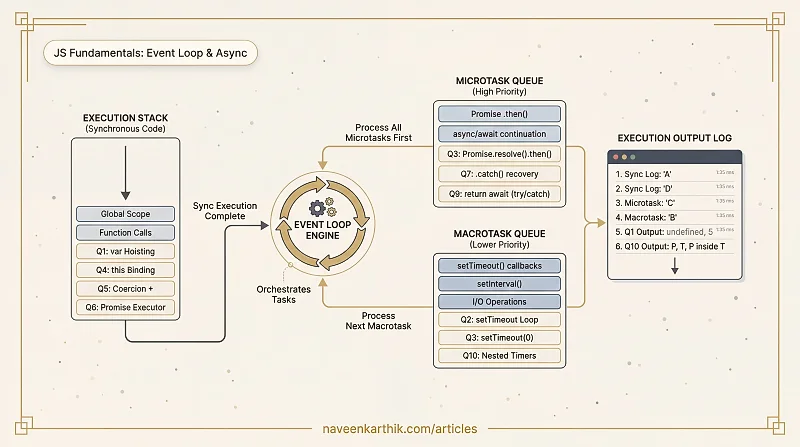
Ten entry-level output questions sampling one fundamental concept from each major area — scope, closures, event loop, this, coercion, promises, chaining, combinators, async/await, and setTimeout interleaving. If you can answer all ten cold, your JS async fundamentals are interview-ready.
Q1 — var hoisting
Loading editor...
Show answer
Output:
undefined
5
Why: var x is hoisted to the top of its scope and initialized to undefined. So the first console.log(x) sees undefined — not a ReferenceError (which is what let/const would give). The assignment x = 5 runs inline, so the second log sees 5.
Q2 — Classic var loop + setTimeout
Loading editor...
Show answer
Output:
3
3
3
Why: var i is function-scoped — there is only one i. By the time the setTimeout callbacks run (macrotasks), the loop has finished and i is 3. All three callbacks close over the same i variable and log its current value: 3. Change var to let and you get 0, 1, 2.
Q3 — setTimeout(0) vs Promise.then
Loading editor...
Show answer
Output:
A
D
C
B
Why: Sync code first: "A", "D". Then microtask queue is drained: "C" (.then() callback). Then the macrotask queue runs: "B" (setTimeout callback). Key rule: synchronous → microtasks → macrotasks. Promise .then() always beats setTimeout(0).
Q4 — this binding — method extracted and called standalone
Loading editor...
Show answer
Output:
undefined
Why: fn is called as a standalone function, not as a method of obj. In non-strict mode, this would be the global object (and this.name would be undefined unless there's a global name). In strict mode / ES modules, this is undefined and this.name throws TypeError. The key rule: this is determined by the call-site, not the original object.
Q5 — Type coercion with +
Loading editor...
Show answer
Output:
12
2
105
Why: + with a string operand triggers string concatenation: 1 + "2" → "12". - always coerces to numbers: "3" - 1 → 2. Chained + is left-to-right: 5 + 5 → 10, then 10 + "5" → "105".
Q6 — Promise executor is synchronous
Loading editor...
Show answer
Output:
start
executor
end
Why: The Promise executor function runs synchronously at construction time. "executor" logs between "start" and "end". The resolved value "done" goes nowhere because there is no .then() — but the executor body itself is synchronous.
Q7 — .catch() recovery
Loading editor...
Show answer
Output:
caught: error
then: recovered
Why: .catch() that returns a plain value converts the chain back to the resolved track. The .then() after .catch() runs normally and receives "recovered". This is the recovery pattern — handle the error, return a fallback, and the chain continues.
Q8 — Promise.all preserves input order
Loading editor...
Show answer
Output:
["first", "second", "third"]
Why: Promise.all returns values in input order, not resolution order. Even if the third Promise resolved first, the output array mirrors the input array. This matters when Promises have different resolve times — the array position is always preserved.
Q9 — return vs return await in try/catch
Loading editor...
Show answer
Output:
caught with await: fail
Why: return Promise.reject("fail") exits the try block immediately — the catch never runs. return await Promise.reject("fail") stays inside the try, the await unwraps the rejection into a throw, and the catch intercepts it. withoutAwait() returns a rejected Promise that the caller must handle; withAwait() recovers inside the function.
Q10 — Promise inside setTimeout
Loading editor...
Show answer
Output:
P
T
P inside T
Why: Microtask "P" runs first (after sync). Then the macrotask fires: "T", then queues "P inside T" as a microtask. After that macrotask exits, microtasks drain again: "P inside T". The golden rule: after every macrotask, all microtasks are drained before the next macrotask — including microtasks created by the macrotask itself.
Key Rules
| Topic | Rule |
|---|---|
| Scope | var is hoisted to undefined; let/const hit TDZ |
| Closures | Close over variables, not values; var in loop → all share the same binding |
| Event Loop | Sync → microtasks (Promise, queueMicrotask) → macrotasks (setTimeout) |
| this | Determined by call-site; extracted method loses its object binding |
| Coercion | + with string → concatenation; -/*// → numeric coercion |
| Promises | Executor sync; .then() / .catch() are microtasks |
| .catch() | Returning a value converts chain back to resolved |
| Promise.all | Values in input order; fail-fast on first rejection |
| async/await | return exits try; return await stays and lets catch intercept |
| setTimeout + Promise | Microtask from macrotask runs before next macrotask |
Go Deeper
- Output Quiz #1 — Scope, Hoisting & the TDZ — Q1, Q2 topics
- Output Quiz #3 — The Event Loop & Task Ordering — Q3 topic
- Output Quiz #6 — Promises & async/await Ordering — Q6 topic
- Output Quiz #7 — Promise Chaining & .catch() Recovery — Q7 topic
- Output Quiz #9 — async/await Patterns & return vs return await — Q9 topic
- Output Quiz #14 — Mixed Async Topics (Hard) — the hard sampler