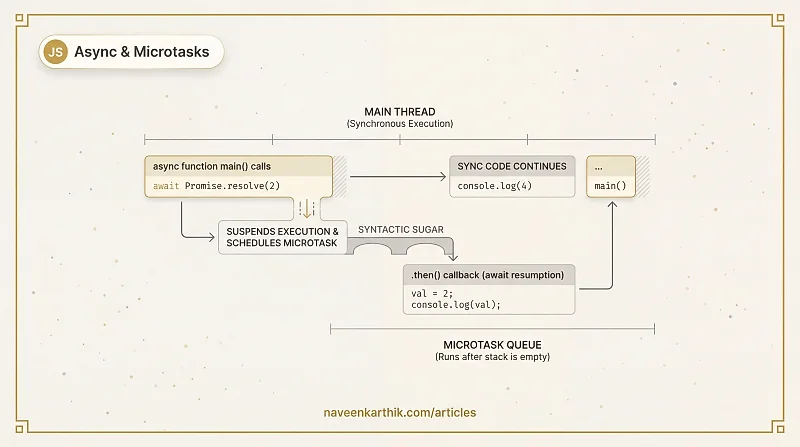
Promises and async/await are the most common source of output-ordering surprises in modern JavaScript interviews. The key insight: Promise callbacks are microtasks, and await is syntactic sugar for .then(). Ten questions to cement that model.
Q1 — Promise executor is synchronous
Loading editor...
Show answer
Output:
before
executor
after
Why: The Promise executor function runs synchronously at the point the Promise is constructed. "executor" logs between "before" and "after". The resolved value "done" goes nowhere here because there's no .then() — but the executor itself is not async.
Q2 — .then() is a microtask
Loading editor...
Show answer
Output:
A
C
B
Why: .then() callbacks are scheduled as microtasks — they don't run until the current synchronous execution completes. "A" and "C" run synchronously; only after the call stack is empty does the microtask "B" run.
Q3 — Returning a value from .then()
Loading editor...
Show answer
Output:
4
Why: Each .then() receives the return value of the previous handler. 1 + 1 = 2, then 2 * 2 = 4, then 4 is logged. Returning a non-Promise value from .then() wraps it in a resolved Promise for the next handler.
Q4 — async function return value
Loading editor...
Show answer
Output:
true
42
Why: An async function always returns a Promise, even if you return a plain value. getValue() returns Promise.resolve(42). So result instanceof Promise is true. The .then() callback receives 42 as a microtask.
Q5 — await pauses, then resumes
Loading editor...
Show answer
Output:
1
4
2
3
Why: main() runs synchronously until await. 1 logs. The await suspends main() and schedules the rest as a microtask, returning control to the caller. 4 logs synchronously. Then the microtask resumes: val is 2, 2 and 3 log.
Q6 — Promise.all ordering
Loading editor...
Show answer
Output:
sync
first second
Why: "sync" runs before the await resolves (microtask). Promise.all resolves when all input Promises resolve — since both are already resolved, it resolves immediately. The destructured values maintain input order regardless of resolution order: a = "first", b = "second".
Q7 — Rejected Promise and .catch()
Loading editor...
Show answer
Output:
catch: error
after catch
Why: A rejection skips all .then() handlers until it finds a .catch() (or a .then(null, onReject) handler). The .then after .catch runs because .catch returned a resolved Promise (it didn't re-throw). The chain is back to the resolved track after the .catch.
Q8 — try/catch with async/await
Loading editor...
Show answer
Output:
caught: oops
done
Why: await on a rejected Promise throws at the await expression — which the surrounding try/catch can intercept. "never" is unreachable. After the catch block handles the error, execution continues normally, so "done" logs.
Q9 — Promise.all vs sequential await
Loading editor...
Show answer
Output:
sync
a b
a b
Why: Both sequential() and parallel() suspend at await, so "sync" logs first. For these already-resolved Promises, timing is similar — but in real code with delays, parallel() would resolve faster because both Promises run concurrently. The logged output is the same (a b twice) because the values are the same; the order between the two functions depends on microtask scheduling. sequential has two awaits (two microtask checkpoints), parallel has one, so parallel's .then is scheduled one microtask later — but with resolved promises they interleave such that both log on the same microtask "beat."
Q10 — Unhandled rejection
Loading editor...
Show answer
Output:
after fail()
(UnhandledPromiseRejection warning in Node / unhandledrejection event in browser)
Why: fail() returns a rejected Promise (because async functions convert thrown errors into rejections). The rejection is not handled (no .catch(), no await inside a try/catch). "after fail()" logs synchronously before the rejection is processed. Node.js emits an UnhandledPromiseRejection warning; browsers fire the unhandledrejection event. The key point: an unhandled rejection inside an async function is silent until the engine checks for it.
Key Rules
| Pattern | Behaviour |
|---|---|
| Promise executor | Runs synchronously |
.then() / .catch() | Scheduled as microtasks — run after current sync code |
async function | Always returns a Promise |
await expr | Suspends the function; the rest runs as a microtask |
Returned value from .then() | Wrapped in a resolved Promise for the next handler |
Thrown error / rejected await | Jumps to nearest .catch() or try/catch |
Promise.all | Resolves when all resolve; preserves input order |
Go Deeper
- Async #3 — Building a Promise from Scratch — implement the Promise state machine
- Async #5 — async/await Under the Hood — how
awaitdesugars to generators + Promises - Output Quiz #5 — Type Coercion & Equality Traps — the previous quiz
- Output Quiz #7 — Promise Chaining & the .catch() Recovery Rules — the next quiz
- Output Quiz #3 — The Event Loop & Task Ordering — the microtask model in depth