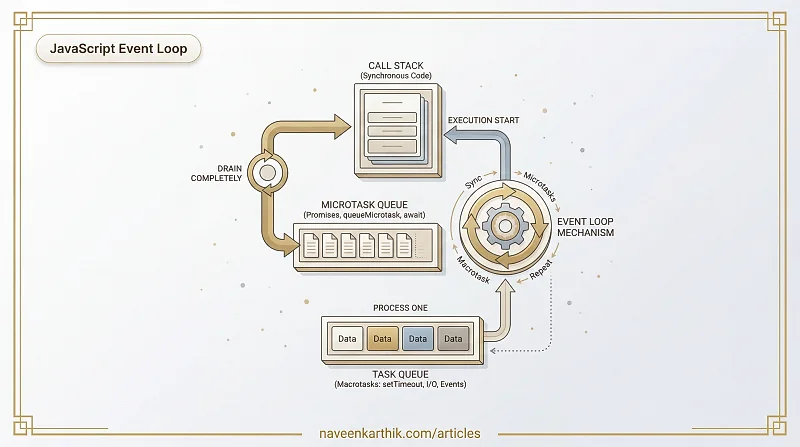
The event loop is the most counter-intuitive topic in JS interviews because the output depends on understanding three separate queues: the call stack, the microtask queue, and the task queue. Ten questions that will sharpen your mental model of execution order.
Q1 — setTimeout(0) vs synchronous code
Loading editor...
Show answer
Output:
A
C
B
Why: console.log("A") and console.log("C") run synchronously on the call stack. setTimeout schedules "B" as a macrotask — it goes into the task queue and only runs after the current synchronous execution is complete. Even with a delay of 0, the callback never jumps the queue ahead of synchronous code.
Q2 — Promise vs setTimeout
Loading editor...
Show answer
Output:
start
end
promise
timeout
Why: Execution order: synchronous code first (start, end), then the microtask queue is drained (.then callbacks), then the task queue runs (setTimeout callbacks). Promise .then callbacks are microtasks — they always run before the next macrotask. setTimeout is a macrotask, so it waits even though its delay is 0.
Q3 — Chained .then()
Loading editor...
Show answer
Output:
sync
1
2
3
Why: console.log("sync") runs first (synchronous). Then the microtask queue is processed: the first .then runs (logs 1, returns 2), which schedules the second .then as a new microtask (logs 2, returns 3), which schedules the third (logs 3). Each .then callback is enqueued only after the previous one completes.
Q4 — queueMicrotask vs setTimeout
Loading editor...
Show answer
Output:
sync
micro
macro
Why: queueMicrotask explicitly enqueues a microtask — same queue as Promise.then. The microtask queue is drained completely after each task, before the next macrotask runs. So order is: synchronous → microtasks → macrotasks.
Q5 — async/await interleaving
Loading editor...
Show answer
Output:
before
foo start
after
foo after await
Why: foo() is called synchronously. Inside foo, "foo start" logs immediately. Then await Promise.resolve() suspends foo — it schedules the rest of the function ("foo after await") as a microtask and returns control to the caller. "after" logs synchronously. Then the microtask runs: "foo after await".
Q6 — Multiple awaits
Loading editor...
Show answer
Output:
1
4
2
3
Why: run() executes synchronously until the first await null. At that point it suspends, returning control: 4 logs. Then the microtask for the resumed run() fires: 2 logs. The second await null suspends again, but there's no more synchronous code, so the next microtask fires immediately: 3 logs.
Q7 — Promise constructor is synchronous
Loading editor...
Show answer
Output:
A
B
D
C
Why: The Promise executor function ((resolve) => { ... }) runs synchronously when the Promise is constructed. So "B" logs immediately. The .then callback ("C") is a microtask — it runs after all synchronous code ("D") completes.
Q8 — Nested setTimeout
Loading editor...
Show answer
Output:
1
3
4
2
Why: Both outer setTimeouts are queued as macrotasks. The first runs: logs 1, schedules a new macrotask for 2, logs 3. Then the second outer setTimeout runs (it was queued before the inner one): logs 4. Finally the innermost setTimeout runs: logs 2. Nested setTimeout pushes to the back of the task queue, behind already-scheduled tasks.
Q9 — Promise then vs async/await mixing
Loading editor...
Show answer
Output:
start
a1
b1
end
a2
Why: a() starts synchronously: "a1" logs. await b() calls b() synchronously: "b1" logs. b() returns a resolved promise. The await suspends a() (schedules "a2" as a microtask) and returns control to a()'s caller. "end" logs. Then the microtask runs: "a2".
Q10 — Microtask starvation
Loading editor...
Show answer
Output:
sync done
(hangs — "setTimeout ran" never logs in a real browser)
Why: Each microtask schedules another microtask before the engine can drain the queue. The microtask queue is fully drained before any macrotask runs — so the setTimeout callback never gets a turn. This is microtask starvation: an infinite chain of microtasks prevents all macrotasks (rendering, I/O, timers) from running. In a real browser, this freezes the page.
Key Rules
| Queue | What goes there | When it runs |
|---|---|---|
| Call stack | Synchronous code | Right now |
| Microtask queue | Promise.then, queueMicrotask, await resume | After every task, before next macrotask |
| Task queue (macrotask) | setTimeout, setInterval, I/O, events | One at a time, after microtask queue is empty |
The golden rule: synchronous → all microtasks → one macrotask → all microtasks → one macrotask → …
Go Deeper
- Async #1 — The Event Loop in Depth — call stack, microtask queue, and starvation fully explained
- Performance #6 — The JavaScript Event Loop & Task Queue — why this matters for page performance
- Output Quiz #2 — Closures & the Loop Problem — the previous quiz
- Output Quiz #4 — this Binding & Arrow Functions — the next quiz