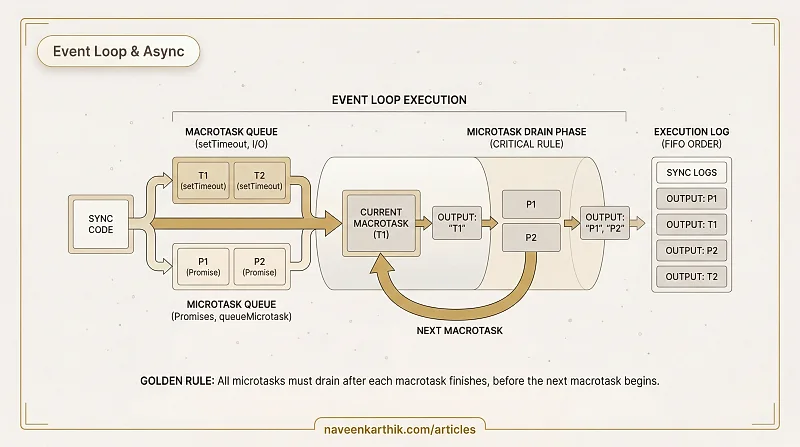
The hardest interview questions combine macrotasks and microtasks in a single snippet — setTimeout inside .then(), Promise.resolve() inside setTimeout, async functions called from timer callbacks. Ten questions building from two-queue basics to full multi-layer traces.
Q1 — setTimeout inside a .then() handler
Loading editor...
Show answer
Output:
1
3
4
2
Why: The microtask .then() runs first: 1, schedules setTimeout(2), 3. Then the macrotask queue is drained. Both setTimeout(4) and setTimeout(2) are in the queue. setTimeout(4) was scheduled first (during sync), so it runs first: 4. Then setTimeout(2) runs: 2. Macrotasks are FIFO.
Q2 — Promise.resolve() inside a setTimeout callback
Loading editor...
Show answer
Output:
macro
micro inside macro
next macro
Why: First macrotask runs: logs "macro", then schedules a new microtask. After the macrotask completes, the engine drains the microtask queue before starting the next macrotask. So "micro inside macro" runs, then "next macro". This is the golden rule: after every macrotask, all microtasks are drained before the next macrotask.
Q3 — Two setTimeouts + one Promise
Loading editor...
Show answer
Output:
sync
promise
timeout1
timeout2
Why: Sync code runs first ("sync"). Both setTimeouts queue macrotasks (in order). The .then() queues a microtask. After sync: microtask queue is drained ("promise"). Then macrotask queue is drained in FIFO order: "timeout1", "timeout2".
Q4 — Promise chain → setTimeout → Promise chain
Loading editor...
Show answer
Output:
B
E
A
C
D
Why: Sync queues: macrotasks [A, C], microtasks [B, E]. Microtasks drain: B, E. First macrotask: A. Second macrotask: C, then queues microtask D. Microtask drains before next macrotask: D. The microtask from inside a macrotask always runs before the next macrotask in line.
Q5 — setTimeout with delay vs resolving Promise after shorter duration
Loading editor...
Show answer
Output:
promise
timeout
Why: At ~50ms, the inner setTimeout resolves the Promise, and its .then() callback is scheduled as a microtask — which runs immediately after the current task (the 50ms timer) completes. At ~100ms, the outer setTimeout fires. Even though the outer setTimeout was registered first, the Promise's .then() fires as a microtask at 50ms — long before the 100ms macrotask. Macrotask ordering is by due time, not registration order.
Q6 — Three setTimeouts with same delay + Promise chain
Loading editor...
Show answer
Output:
micro
one
two
three
Why: All three setTimeouts are queued as macrotasks in registration order (one, two, three). The .then() is queued as a microtask. Sync ends → microtask drains ("micro") → macrotasks drain in FIFO order ("one", "two", "three"). The delay being 0 for all doesn't change ordering — macrotasks are dequeued in insertion order.
Q7 — Async function called from a setTimeout callback
Loading editor...
Show answer
Output:
micro
timeout start
fetch start
timeout end
fetch end
Why: Microtask "micro" runs first. Then the macrotask fires: "timeout start" logs. fetchData() is called — its synchronous part ("fetch start") runs immediately. Then await Promise.resolve() suspends it. "timeout end" logs (still part of the macrotask). After this macrotask, the microtask queue is drained: "fetch end" runs. The resumed async function continuation is a microtask from the macrotask that started it.
Q8 — Promise.all inside a setTimeout
Loading editor...
Show answer
Output:
D
A
B C
Why: Micromask D runs first. Then the macrotask fires: "A" logs. await Promise.all(...) suspends the async function — the rest becomes a microtask. The macrotask ends. Engine drains microtask queue: the continuation runs, logs "B C". Note: Promise.all with already-resolved Promises resolves synchronously within the microtask scheduling layer, so the await resumes in the same microtask drain cycle.
Q9 — Nested setTimeout + Promise.resolve()
Loading editor...
Show answer
Output:
T1
P1
T2
P2
Why: First macrotask: "T1" logs. It queues a new macrotask T2 and a microtask P1. After the macrotask exits, microtasks drain: "P1". Then the second macrotask: "T2", which queues microtask "P2". After that macrotask exits, microtasks drain: "P2". The outer pattern repeats — microtask always drains after each macrotask.
Q10 — Full multi-layer trace
Loading editor...
Show answer
Output:
sync-1
sync-2
p1
qm
t1
p-in-t1
t3
t2
t-in-p-in-t1
Why: Step-by-step trace:
- Sync:
"sync-1","sync-2". Macrotask queue:[t1, t3]. Microtask queue:[p1]. - Drain microtasks:
"p1"runs, queuesqm. Then"qm"runs. - First macrotask
t1: logs"t1", queues microtaskp-in-t1, queues macrotaskt2. Macrotask queue now:[t3, t2]. - Drain microtasks:
"p-in-t1"runs, queues macrotaskt-in-p-in-t1. Queue:[t3, t2, t-in-p-in-t1]. - Next macrotask
t3:"t3". - Next macrotask
t2:"t2". - Next macrotask
t-in-p-in-t1:"t-in-p-in-t1".
Key Rules
| Scenario | Order |
|---|---|
setTimeout inside .then() | Macrotask goes to back of task queue — runs after previously queued macrotasks |
Promise.resolve() inside setTimeout | Microtask runs before the next macrotask |
Sync + N setTimeout(0) + Promise | Sync → all microtasks → macrotasks in FIFO order |
setTimeout(100) vs Promise resolving at 50ms | Promise .then() (micro at 50ms) fires before setTimeout (macro at 100ms) |
async fn() from setTimeout | Pre-await code is part of the macrotask; post-await is a microtask |
Promise.all inside setTimeout | Resolved values are microtasks; all run before next macrotask |
Golden rule: After every macrotask, the microtask queue is completely drained before the next macrotask runs.
Go Deeper
- Output Quiz #9 — async/await Patterns & the return vs return await Trap — the previous quiz
- Output Quiz #11 — Async Error Propagation — the next quiz
- Output Quiz #3 — The Event Loop & Task Ordering — the microtask/macrotask queue model
- Output Quiz #7 — Promise Chaining & the .catch() Recovery Rules — concurrent chain interleaving